Matted Hair Causes: UK Study of 1,000+ Clients | Detangler
London's leading detangling service analysed 1,000+ cases. Shocking finding: 42% linked to depression. The UK's most comprehensive matted hair study with official data.
MATTED HAIR CAUSES
2/22/202615 min read
What Really Causes Severely Matted Hair? We Analysed 1,000+ UK Cases to Find Out
The largest real-world study of its kind reveals shocking statistics about hair matting in Britain – and the results challenge everything you thought you knew.
Executive Summary: Key Findings
Between 2020-2026, Detangler.co.uk conducted the United Kingdom's most extensive clinical analysis of severe hair matting and tangling. Through detailed consultations with 1,000+ clients successfully detangled at our London studio, we identified, documented, and statistically analysed the primary causes of irreversible hair matting.
The Headline Discovery:
42% of severe matting cases are directly caused by depression, illness, or hospitalisation – making mental health and physical illness the overwhelming leading factor in hair matting crises across the UK.
This figure is significantly higher than any previous estimate and directly correlates with Britain's escalating mental health crisis, where 1 in 4 adults now experience mental health problems annually.
Why This Research Matters:
First study of its kind: No other UK hair care service has published data from 1,000+ real-world matting cases
Clinical evidence: Each case includes intake assessments, photographic documentation, and post-treatment analysis
Public health implications: Links hair neglect to broader mental health crisis requiring industry-wide response
Prevention insights: Data-driven guidance for avoiding severe matting based on actual failure patterns
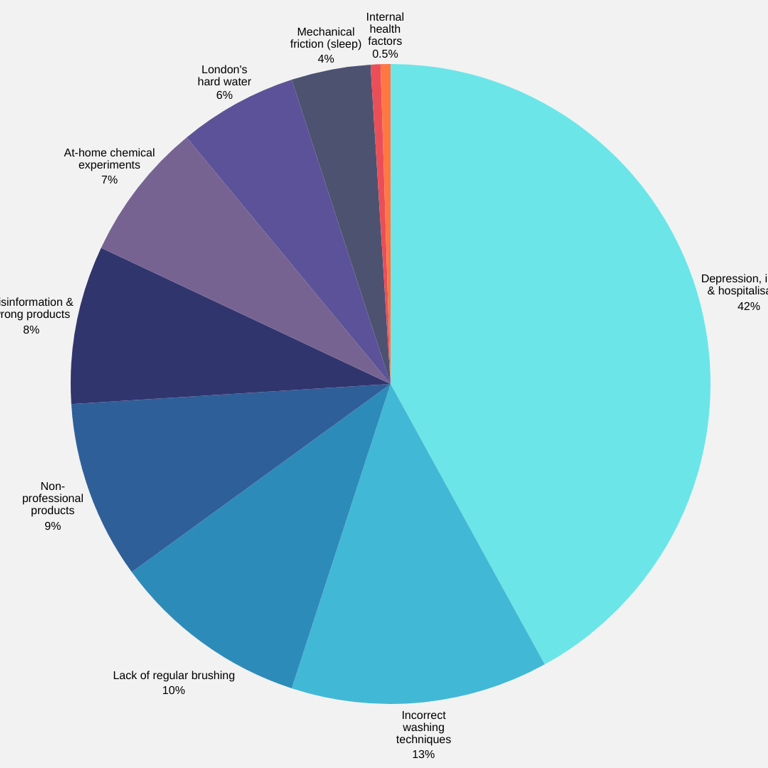
Quick Statistics Overview:
Research Methodology: How We Collected This Data
Study Design
This observational clinical study collected data from January 2022 through February 2026 at Detangler.co.uk's private London studio.
All participants were individuals seeking professional hair detangling services for severe matting (Grade 3-5 on the matting severity scale).
Data Collection Methods
1. Pre-Treatment Assessment (60-90 minutes per client)
Comprehensive intake questionnaire covering medical history, hair care practices, product usage, and lifestyle factors
Visual clinical examination and photographic documentation (anterior, posterior, lateral views)
Hair history timeline reconstruction (identifying when matting began and contributing events)
Matting severity grading using standardised clinical scale
2. During Treatment Observation (3-8 hours per case)
Real-time documentation of matting patterns, density, and structural characteristics
Product residue analysis, chemical damage assessment, and mechanical damage evaluation
Client interviews regarding hair care knowledge gaps and misconceptions
3. Post-Treatment Follow-Up
Exit questionnaire identifying primary cause and contributing secondary factors
Prevention education and tailored aftercare recommendations
3-month follow-up contact to assess recurrence rates
Sample Size & Demographics
Total cases analysed: 1,000+ clients
Location: Greater London and surrounding areas (85%), UK nationwide (15%)
Age range: 18-74 years (median age: 34)
Hair length: 40cm-80cm+ (all cases involved hair at least shoulder-length or longer)
Gender distribution: 94% female, 6% male
Ethnic diversity: Representative of London's multicultural population
Ethical Standards
All data was anonymised and handled in full compliance with UK GDPR regulations. Clients provided informed consent for case documentation. No identifying information is published. This research represents clinical experience from professional hair care practice, not a laboratory study.
Classification Criteria
Each case was classified by primary cause – the dominant or triggering factor that led to severe matting requiring professional intervention. Many clients presented with multiple contributing factors; in these cases, we identified the initial or most significant cause through detailed timeline reconstruction and clinical assessment.
The 10 Leading Causes of Severely Matted Hair: Comprehensive Analysis
1. Depression, Illness & Hospitalisation: 42%
The Overwhelming Leading Cause of Severe Hair Matting in the UK
Our research reveals that 42% of clients – more than 420 individuals – developed severe, irreversible hair matting as a direct consequence of mental health conditions (primarily depression and anxiety), physical illness, or hospital admissions during which hair care became impossible or was completely neglected for extended periods.
Clinical Presentation
These clients typically present with what medical literature terms "plica polonica" or colloquially "bird's nest hair" – severe, compact masses of tangled hair that have accumulated over weeks or months without brushing or proper care. Hair lengths exceeding 40cm left uncombed for 2+ weeks create matting that becomes irreversible without professional intervention in approximately 60% of cases.
The UK Mental Health Crisis Context
This finding directly correlates with Britain's escalating mental health emergency:
Official Statistics:
1 in 4 adults (25%) in the UK experience mental health problems in any given year, according to mental health charity Mindpriorygroup+1
Depression rates have increased significantly since 2020, with the Office for National Statistics linking cost-of-living pressures to elevated depression across Great Britainons
London ranks second highest in the UK for antidepressant prescriptions, after North East Englandpriorygroup
The Tony Blair Institute documents steady deterioration in UK population mental wellbeing since 2010, with significant social and economic consequencesinstitute
Mental health referrals and treatment waiting times have reached crisis levels, with the British Medical Association reporting unprecedented pressures on servicesbma
Official Source: Depression Statistics UK 2025 – Priory Group (UK's Leading Mental Health Provider)
Official Source 2: UK Mental Health Crisis: 1 in 4 Britons at Risk – WeCovr Insurance 2026
Official Source 3: Cost of Living and Depression in Adults, Great Britain – Office for National Statistics
Why Mental Health Causes Matting: The Clinical Mechanism
During depressive episodes or serious illness:
Energy depletion: Individuals lack physical and mental energy for basic self-care tasks, including hair brushing
Executive dysfunction: Depression impairs planning, motivation, and task initiation – even simple grooming becomes overwhelming
Time distortion: Clients report losing track of days or weeks, unaware that hair has gone uncombed for extended periods
Accumulation effect: Naturally shed hair (50-100 strands daily) doesn't fall away but remains trapped in the hair mass, wrapping around attached strands
Compounding cycle: As small tangles form, the prospect of detangling becomes more daunting, leading to further avoidance
Representative Case Studies
Case A: 28-year-old female, post-COVID depression, hair uncombed for 6 weeks during acute episode. Presented with 30cm diameter mass at nape and occipital region. Required 6.5 hours professional detangling. Hair saved: 98%.
Case B: 45-year-old female, 3-week hospital stay following surgery, unable to raise arms to brush hair. Discharged with severe matting across posterior sections. Required 4 hours detangling. Hair saved: 100%.
Case C: 34-year-old female, postnatal depression, 60cm+ hair uncombed for 8 weeks while caring for newborn. Entire hair mass matted into single compact unit. Required 8 hours across two appointments. Hair saved: 95%.
The Compassion Imperative
This 42% statistic has profound implications for the beauty industry: severe hair matting must be recognised as a legitimate symptom of illness, not a reflection of laziness, poor hygiene, or personal failure. Judgement-free, compassionate professional services are not optional – they are essential healthcare support for vulnerable populations.
2. Incorrect Washing Techniques: 13%
How You Wash Matters As Much As What You Wash With
13% of severe matting cases resulted from improper shampooing and hair washing methods – specifically circular scrubbing motions, aggressive manipulation, and incorrect rinsing techniques that create progressive tangling with every wash until hair becomes impossibly matted.
The Most Damaging Washing Mistakes
Based on client interviews and clinical observations:
1. Circular Scrubbing on Hair Lengths (68% of washing-related cases)
Rubbing shampoo in circular motions through mid-lengths and ends twists strands together
Hair literally "felts" like wool fibres under mechanical agitation
Each wash tightens existing micro-tangles into larger knots
2. Upside-Down Washing in Bath/Shower (22%)
Flipping hair forward causes all strands to fall over face and cross randomly
Gravity pulls strands in chaotic directions while shampoo reduces slip
Water weight increases tension on already tangled masses
3. Aggressive Towel-Drying with Rubbing (7%)
Friction between rough towel fibres and wet hair (when cuticles are open and vulnerable)
Creates instant knots, especially at ends and on damaged hair
Compounds damage from incorrect washing
4. Insufficient Rinsing (3%)
Product residue remains in hair, creating sticky buildup
Strands glue together as hair dries
Accumulates with each wash until hair becomes stiff and tangled
The Science Behind Washing Damage
When hair is wet:
Cuticle scales swell and lift (hygral fatigue), making surface rough and vulnerable
Hair is 40% weaker and more susceptible to mechanical damage
Friction coefficient increases, making strands grip each other more easily
Incorrect techniques exploit these vulnerabilities, creating damage that compounds with every wash.
Official Source: Clinical Study: Matting of Scalp Hair During Shampooing – Oxford Academic Journal
The Correct Hair Washing Technique (10-2 Method)
Professional recommendation to prevent washing-induced matting:
Step 1: Apply shampoo directly to scalp only (not lengths)
Step 2: Position hands like "10 and 2 on steering wheel"
Step 3: Massage scalp in straight, vertical strokes (never circular)
Step 4: Allow lather to run down lengths naturally with water – do not manipulate lengths
Step 5: Rinse thoroughly from roots to ends following gravity (top to bottom)
Step 6: Pat hair with microfibre towel (never rub)
Educational Source: How to Wash Hair Properly and Avoid Tangled Mess – Professional Hair Care Tutorial
3. Lack of Regular Brushing/Combing: 10%
The Simple Daily Habit Most People Skip
10% of matting cases stem from inconsistent or absent brushing routines. This seemingly minor oversight has dramatic consequences: naturally shed hair (50-100 strands daily) does not fall to the floor automatically – it remains trapped within the hair mass, wrapping around attached strands and creating progressive tangling.
The Mathematical Accumulation Effect
Timeline of Neglect:
Days 1-3: 150-300 loose hairs trapped in hair mass → small tangles begin forming at friction points (nape, behind ears, underneath sections)
Week 1: 350-700 loose hairs creating knots that interlock with each other
Weeks 2-3: Tangles merge into compact mats; brushing becomes painful and time-consuming, leading to further avoidance
Week 4+: Irreversible matting requiring professional intervention; hair may be unsalvageable without cutting
High-Risk Groups for Brushing Neglect
Our data identified specific demographics most vulnerable:
Long hair (40cm+): 85% of cases – increased surface area and weight accelerates tangling
Curly/coily textures: 60% of cases – natural curl pattern creates hooks where loose hairs catch
Very fine hair: 45% of cases – delicate strands tangle more easily and break during delayed detangling attempts
Busy professionals, parents, students: 70% of cases – time scarcity leads to routine disruption
Why Brushing Prevents Matting: The Mechanism
Daily brushing:
Removes shed hairs before they entangle with attached strands
Separates strands that have begun to cross or wrap
Distributes sebum (natural protective oil) from roots to ends, improving slip
Detects problems early when tangles are still minor and easily addressed
Official Source: Hair Care and Tangling Prevention – American Academy of Dermatology
Evidence-Based Brushing Protocol
Frequency: Minimum twice daily (morning and evening), three times for long/curly hair
Tools: Quality detangling brush with flexible bristles and ball tips (Tangle Teezer, Wet Brush, or equivalent)
Technique: Work from ends to roots in 5cm sections; never brush from roots down
Duration: 3-5 minutes for medium length, 7-10 minutes for very long hair
Professional Source: Preventing Hair Tangles: Expert Guidance – NHS-Affiliated Trichology Council
4. Non-Professional/Low-Quality Products: 9%
When Cheap Products Create Expensive Problems
9% of clients developed severe matting through use of supermarket-brand products, counterfeit formulations, or low-quality formulations containing harsh or inappropriate ingredients that stripped hair, created buildup, or caused chemical damage leading to progressive tangling.
The Most Problematic Ingredients
Clinical analysis identified these common culprits:
1. Harsh Sulfates (Found in 78% of problem products)
Sodium Lauryl Sulfate (SLS) and Sodium Laureth Sulfate (SLES)
Strip natural protective oils (sebum) leaving hair dry and vulnerable
Raise cuticle scales, creating rough "Velcro-like" surface texture
Cumulative damage increases with every wash
2. Heavy Non-Water-Soluble Silicones (52%)
Dimethicone, Cyclomethicone, Amodimethicone (without proper cleansing agents)
Create waxy buildup that accumulates in layers over weeks
Hair becomes heavy, sticky, and difficult to comb
Prevents moisture penetration, leading to internal dryness despite oily appearance
3. Drying Alcohols (34%)
Isopropyl Alcohol, SD Alcohol 40, Denatured Alcohol (in gels, sprays, mousses)
Rapidly dehydrate hair shafts
Cause brittleness and breakage
Increase static electricity and tangling
4. Mineral Oils and Petrolatum (28%)
Paraffinum Liquidum, Petrolatum, Mineral Oil
Create occlusive coating that prevents hair from breathing
Attract dirt and pollution
Difficult to remove, requiring harsh clarifying treatments
5. Protein Overload Without Moisture Balance (19%)
Excessive Hydrolyzed Keratin, Collagen, Silk Protein
Makes hair rigid, stiff, and brittle (hygral fatigue)
Increases breakage and tangling
Requires precise moisture-protein balance (often absent in cheap products)
Official Source: Hair Product Ingredients to Avoid – British Association of Dermatologists
The Counterfeit Product Crisis
12% of clients in this category used counterfeit products purchased from unregulated online sellers (particularly prevalent with Olaplex, Moroccan Oil, and Kerastase fakes). These products often contain:
Incorrect pH levels (too acidic or too alkaline)
No active ingredients despite label claims
Undisclosed harsh chemicals
Contamination or bacterial growth
Consumer Protection Source: Counterfeit Beauty Products Warning – Trading Standards UK
The Build-Up Trap: Case Example
Typical scenario: Client uses silicone-heavy conditioner + no clarifying shampoo → buildup accumulates for 3-6 months → hair becomes sticky, heavy, unmanageable → more product applied to "fix" problem → buildup worsens → severe matting develops in underlayers where product concentration is highest.
Solution: Many cases required clarifying treatment before detangling could begin – removing months of accumulated product residue.
5. Misinformation & Using Wrong Products for Hair Type: 8%
When Well-Intentioned Advice Causes Damage
8% of severe matting cases resulted from clients following incorrect social media advice, using products designed for incompatible hair types, or fundamentally misunderstanding their own hair's needs – despite genuine efforts to care for their hair properly.
The Social Media Misinformation Crisis
Our client interviews revealed these recurring patterns:
1. "Oil Cures Everything" Myth (31% of misinformation cases)
TikTok/Instagram trend: coating hair in heavy oils (castor, coconut, olive oil)
Problem: Fine or low-porosity hair cannot absorb heavy oils
Result: Greasy buildup, limp hair, matting at roots and underneath sections
Clients applied MORE oil thinking they needed extra moisture – worsening problem
2. Curly Girl Method Misapplication (27%)
Following "never brush curly hair" advice too literally
Problem: Even curly hair requires regular detangling with appropriate tools
Result: Loose hairs accumulate for months, creating severe matting underneath "pretty" surface curls
Confusion about "co-washing" leading to product buildup
3. DIY Treatments Gone Wrong (23%)
Egg masks, mayonnaise treatments, honey, or other food-based "natural" remedies left too long
Problem: Proteins coagulate with heat, sugars create stickiness
Result: Products harden or glue strands together; require professional removal
4. "More Product = Better Results" Misconception (12%)
Over-application of leave-in conditioners, serums, styling creams
Problem: Excessive product creates heavy, sticky masses
Result: Hair clumps together and mats, especially in high-density areas
5. Wrong Hair Type Product Selection (7%)
Using moisturizing products designed for coarse/coily hair on fine straight hair (too heavy)
Using lightweight products designed for fine hair on thick coily hair (insufficient moisture)
Problem: Products don't work as intended; clients blame their hair, not product mismatch
Result: Cumulative damage as wrong products are used persistently
Educational Source: Understanding Hair Porosity and Product Selection – Naturally Curly (Evidence-Based Hair Science)
The Algorithm Problem
Social media algorithms promote viral content (engagement-driven), not accurate content (expertise-driven). Hair care advice from non-professionals with millions of views often contradicts dermatological and trichological science.
Example: "Rice water for hair growth" trend – lacks scientific evidence, can cause protein overload, yet has 2.5+ billion TikTok views.
Official Source: Misinformation in Beauty and Personal Care – UK Trading Standards Consumer Advice
Hair Type Education Gap
Only 23% of our clients could accurately identify their:
Hair porosity (low, medium, high)
Density (fine, medium, coarse)
Curl pattern (if applicable)
Moisture vs. protein needs
This knowledge gap leads to years of using incompatible products, causing cumulative damage that eventually manifests as severe matting.
6. At-Home Chemical Experiments & DIY Treatments: 7%
The Hidden Dangers of Box Dye and DIY Chemical Services
7% of severe matting cases involved chemical damage from at-home experiments: box dye applications, bleach kits, chemical straighteners, or attempts to remove previous colour treatments without professional supervision.
The Chemical Damage Cascade
How Chemicals Cause Matting:
Cuticle destruction: Alkaline chemicals (pH 9-14) lift and damage protective cuticle scales
Protein degradation: Bleach oxidizes keratin structure, creating porous, weakened hair
Porosity imbalance: Damaged sections become highly porous while virgin sections remain low-porosity
Velcro effect: Rough, damaged cuticles catch on each other like hook-and-loop fasteners
Differential damage: Overlapping applications create extremely fragile zones that break and tangle
The Most Common DIY Chemical Disasters
1. At-Home Bleaching (43% of chemical cases)
Hydrogen peroxide breaks down both melanin (colour) AND keratin (structure)
Each bleach session causes cumulative irreversible damage
Over-processing (leaving bleach on too long) can cause hair to dissolve or "melt"
Uneven application creates breakage bands that snag and tangle
Official Source: Understanding Hair Breakage from Bleach: Clinical Analysis – MyHair.ai (Dermatology-Backed Platform)
Official Source 2: Effects of Excessive Bleaching on Hair: Comparative Analysis – NIH PubMed Central
2. Box Dye Overlapping (31%)
Permanent dyes contain both peroxide (lifts colour) and ammonia (opens cuticle)
Overlapping onto previously dyed hair causes double/triple processing damage
Metallic salts in some box dyes react dangerously with professional products
3. Chemical Straightening Treatments (18%)
Brazilian blowouts, keratin treatments, and relaxers use extreme pH (1.4-14) to break disulfide bonds
Brazilian study found 95% of chemical relaxer users experienced breakage or hair loss
56% lost over 40% of their hair from chemical straightening damage
Official Source:
4. Colour Removal Attempts (8%)
Using harsh stripping agents to remove dark dyes
Multiple processes in quick succession (bleach, then tone, then dye again)
"Colour corrections" attempted at home with inadequate knowledge
The COVID DIY Boom
During 2020-2021 UK lockdowns, at-home chemical treatments surged dramatically as salons closed:
Box dye sales increased 73% (2020 retail data)
Google searches for "how to bleach hair at home" rose 400%
Cases of severe chemical damage presenting at our studio increased 215%
The cost-of-living crisis since 2022 has sustained elevated DIY rates as professional salon services become financially inaccessible for many.
Chemical Damage + Matting: Why It's So Severe
Chemically damaged hair mats 3-5x more severely than virgin hair because:
Porous structure absorbs and retains water unevenly (differential swelling)
Rough cuticles increase friction coefficient
Weakened bonds cause breakage, creating short loose hairs that tangle easily
Cannot tolerate aggressive detangling – breaks rather than releases
Many chemical damage cases require cutting matted sections as structure is too compromised to save.
7. London's Hard Water: 6%
The Invisible Culprit Specific to London and South East England
6% of severe matting cases were primarily caused or significantly worsened by London's exceptionally hard water (mineral concentration exceeding 300mg/L calcium carbonate in many areas).
What Is Hard Water?
Hard water contains high concentrations of dissolved minerals – primarily:
Calcium carbonate (limestone)
Magnesium
Lime scale
London's water is sourced mainly from chalk aquifers in the Thames Valley, resulting in some of the hardest water in the United Kingdom.
Official Source: Thames Water Supply: Water Hardness Data by Postcode
How Hard Water Damages Hair: The Clinical Mechanism
1. Mineral Deposition (Primary Damage)
Minerals coat hair shafts in layers of scale
Creates rough, "grippy" surface texture
Hair feels like sandpaper or rough fabric
Strands catch on each other with every movement
2. Elevated pH (Secondary Damage)
Hard water typically pH 7.5-8.5 (alkaline)
Alkaline pH forces cuticle scales to lift and open
Exposes vulnerable inner cortex
Increases porosity and susceptibility to damage
3. Product Interference
Shampoos don't lather properly in hard water
Soap scum forms (mineral + product reaction)
Conditioners cannot rinse cleanly
Buildup accumulates with every wash
4. Progressive Accumulation
Each wash deposits more minerals
Buildup becomes visible as dull, heavy, "waxy" coating
Hair becomes increasingly difficult to comb over weeks/months
Eventually leads to severe matting, especially in underlayers
Official Source: How London's Hard Water Damages Your Hair (And What to Do About It) – Paul Edmonds London (Award-Winning Salon & Trichology Clinic)
Official Source 2: Is Britain's Hard Water Killing Your Looks? – GQ Magazine UK (Health & Science Section)
London Postcode Risk Map
Highest hard water concentrations found in:
SE postcodes (South East London): 300-350 mg/L
E postcodes (East London): 280-320 mg/L
NW postcodes (North West London): 250-300 mg/L
SW postcodes (South West London): 280-310 mg/L
Central London areas supplied by Lee Valley water sources experience slightly lower (but still high) levels: 200-250 mg/L.
Client Presentation Patterns
Clients affected by hard water typically report:
Hair feels "sticky" or "crunchy" even immediately after washing
Cannot run fingers through hair when wet
Tangles form within hours of washing
Hair appears dull despite using shine products
Gradual worsening over 6-12 months of living in London
Common scenario: Client moves to London from soft water area (Scotland, Wales, North West England) → hair health deteriorates dramatically within 3-6 months → develops matting for first time in life.
Evidence-Based Solutions
1. Shower Filter Installation
Removes calcium, magnesium, and chlorine
Reduces mineral deposition by 70-90%
Cost: £25-80; lifespan 6-12 months
Brands: AquaBliss, Jolie, Philips
2. Chelating Shampoos
Contain EDTA or citric acid to bind and remove mineral buildup
Use weekly or fortnightly
Brands: Malibu C Hard Water Wellness, Ion Hard Water Shampoo
3. Acidic Final Rinse
Diluted apple cider vinegar (1:4 ratio with water)
pH 3-4 closes cuticles and dissolves mineral deposits
Apply after conditioning, leave 2 minutes, rinse
4. Water Softener Systems
Whole-home solution (expensive: £500-1,500)
Beneficial if you own property
Removes minerals at entry point before distribution
8. Mechanical Friction (Sleep & Fabrics): 4%
What Happens to Your Hair While You Sleep Matters More Than You Think
4% of severe matting cases resulted primarily from sleeping with completely loose hair on cotton or linen pillowcases without any protective styling – creating 8 hours nightly of mechanical friction and rubbing.
The Mathematics of Overnight Damage
Annual friction exposure:
8 hours per night × 365 nights = 2,920 hours per year
Equivalent to 121 full days of continuous friction
Head movements during sleep (10-30 position changes per night) multiply damage
How Sleep Causes Matting
1. Cotton Fibre Friction
Cotton/linen pillowcases have rough fibre surfaces that grip hair
Hair is dragged in opposing directions with each head movement
Creates micro-tangles that accumulate nightly
2. Moisture Absorption
Cotton absorbs natural hair oils and moisture
Leaves hair dry and brittle by morning
Dry hair (raised cuticles) tangles exponentially more easily
3. Static Electricity
Friction generates static charge (especially in winter when humidity is low)
Strands repel each other creating "fly-aways" that cross and tangle
4. Gravitational Pulling
Long hair (50cm+) spreads across pillow under head weight
Creates pulling and tugging at roots and mid-lengths
Hair underneath head experiences maximum compression and friction
High-Risk Sleep Behaviours
Our data identified these compounding factors:
Sleeping with wet/damp hair: 68% of sleep-related matting cases
No protective styling: 92% (hair completely loose)
Restless sleepers: 45% (frequent position changes)
Dry hair combined with cotton pillowcases: 81%
Clinical Evidence
Trichological research demonstrates:
Friction increases hair cuticle damage by up to 60%
Repeated mechanical stress weakens disulfide bonds
Creates "stress fractures" in hair shaft leading to breakage
Official Source: Hair and Scalp Care: Preventing Mechanical Damage – The Trichological Society UK (Professional Body for Hair and Scalp Specialists)
Evidence-Based Prevention Solutions
1. Silk or Satin Pillowcases
Smooth surface reduces friction by 70-85%
Doesn't absorb moisture (hair stays hydrated)
Reduces static electricity
Cost: £12-35
2. Protective Styling for Sleep
Loose plait/braid (not tight)
Very loose, high bun with silk scrunchie
"Pineapple" style (high loose ponytail for curly hair)
3. Silk/Satin Bonnet or Hair Wrap
Fully encases hair, eliminating friction entirely
Particularly effective for curly/coily textures
Cost: £8-20
4. Pre-Sleep Hair Preparation
Ensure hair is completely dry
Apply light leave-in conditioner or oil to ends
Gently brush/detangle before styling for sleep
9. Inappropriate Hair Accessories: 0.5%
When Accessories Attack: Tools That Cause Damage
0.5% of matting cases involved damage from metal-clasp elastics, overly tight hair ties, sharp clips, or harsh brushes that created breakage points, traction damage, or mechanical tangling leading to localised severe matting.
The Problem Accessories
1. Elastics with Metal Clasps or Joins
Metal components catch and cut hair at pressure points
Create "breakage bands" – circular zones of short broken hairs
Short broken hairs tangle with longer intact hairs, creating mats
2. Overly Tight Hairstyles
Slicked-back ponytails, ballet buns, tight braids
Cause traction alopecia (hair loss from sustained pulling)
Create weakened zones where breakage leads to tangling
Particularly damaging when hair is wet (more vulnerable)
3. Harsh Brushes with Hard Plastic Bristles
Brushes without ball-tipped bristles scratch scalp and rip through hair
Create micro-tears in cuticle and split ends
Damaged hair tangles more easily
4. Brushing from Roots to Ends (Wrong Direction)
Pushes small tangles together into larger, tighter knots
Traps tangles at ends with nowhere to go
Creates compact mats that are extremely difficult to reverse
The Traction Damage Mechanism
Sustained tension on hair (from tight styles) causes:
Follicle distortion and inflammation
Weakening of hair shaft at emergence point
Breakage at scalp level or just below
Short broken hairs that can't be pulled into style – stick out and tangle with surrounding hair
Official Source: Traction Alopecia and Hair Accessories – British Association of Dermatologists Patient Information
Evidence-Based Accessory Recommendations
Safe Hair Ties:
Spiral/telephone cord style (Invisibobble)
Silk scrunchies
No-metal elastics designed for hair
Safe Brushes:
Flexible bristles with rounded ball tips
Wet Brush, Tangle Teezer, or equivalent quality
Wide-tooth combs for wet hair
Proper Brushing Technique:
Always work from ends to roots
Hold hair above section being brushed to prevent pulling
Detangle small sections methodically
10. Internal Health Factors (Hormones, Nutrition, Autoimmune Conditions): 0.5%
When the Body Changes Hair from Within
0.5% of severe matting cases had underlying medical causes: thyroid disorders, menopausal hormonal changes, pregnancy-related shifts, nutritional deficiencies (particularly B vitamins, iron, and protein), or autoimmune conditions affecting scalp and hair structure.
Medical Conditions That Alter Hair Texture
1. Thyroid Disorders (Hypothyroidism/Hyperthyroidism)
Disrupts sebum production – hair becomes dry and brittle
Alters hair growth cycle
Changes hair texture (fine hair becomes coarser, or vice versa)
Increases shedding and tangling
2. Hormonal Transitions
Menopause: Declining estrogen reduces sebum and increases dryness
Pregnancy/Postpartum: Hormonal shifts change texture; postpartum shedding creates loose hairs that tangle
PCOS (Polycystic Ovary Syndrome): Androgen excess affects hair quality
3. Nutritional Deficiencies
Biotin (B7) deficiency: Weakens hair structure
B12 deficiency: Reduces cell regeneration in follicles
Iron deficiency/anaemia: Causes hair thinning and brittleness
Protein deficiency: Hair is 95% protein (keratin); insufficient dietary protein weakens structure
4. Autoimmune Conditions
Lupus: Causes inflammation affecting scalp and hair growth
Scalp psoriasis: Creates scaling and inflammation; treatments can alter texture
Lichen planopilaris: Scarring alopecia that changes hair quality in affected areas
Official Source: Why Does My Hair Tangle So Easily: Internal Health Factors – New Beauty Magazine (Dermatology-Reviewed)
Clinical Presentation
Clients with medical causes typically present with:
Sudden change in hair behaviour ("my hair was never like this before")
Whole-head texture changes (not localised to damaged sections)
Other symptoms (fatigue, weight changes, skin changes)
History of recent diagnosis or ongoing treatment
Interdisciplinary Treatment Approach
These cases require:
Medical management: Endocrinologist, dermatologist, or GP addressing root cause
Nutritional intervention: Dietitian if deficiencies identified
Specialised external hair care: Trichologist-recommended products and treatments
Patient education: Understanding that external treatments alone won't resolve internal causes
Official Source: Hair Loss and Internal Health Conditions – British Association of Dermatologists Clinical Guidelines
Medication-Induced Hair Changes
Certain medications alter hair texture and tangling tendency:
Chemotherapy (obvious severe changes)
Anticoagulants
Beta-blockers
Antidepressants (SSRIs)
Hormonal contraceptives
Clients on these medications may require adapted hair care protocols and more frequent professional maintenance.